Try Product Data Enrichment Yourself, Not a Demo
Evaluating a product enrichment tool usually starts the same way: a discovery call, then a demo scheduled for the following week. Weeks can pass before you see how the tool handles your own catalog. That gap between "looks promising" and "proven on my data" is where most evaluations lose momentum.
What a Demo Can Show You, and What It Cannot
A demo is built to show a tool at its best, using a clean, curated example. That is a fair way to get a first impression, and it answers a real question: does this look capable? It is just not the only question that matters.
What a Demo Can Show You
- A first impression of what is possible, built around a clean, curated example chosen to show the tool at its best.
- A sense of the interface and the finished output, once everything about the data already lines up.
What a Demo Cannot Show You
- Whether the tool holds up on your messiest supplier feed, your real category mix, your actual gaps.
- What happens when a field is missing or a category does not map cleanly.
- How ai product data enrichment performs on your own catalog, not a demo built to look good.
How to Try Product Data Enrichment on Your Own Catalog
With Dyver, self-serve access flips the order. This product enrichment free trial lets you find out whether enrichment works on your catalog before a single sales conversation happens, not after.
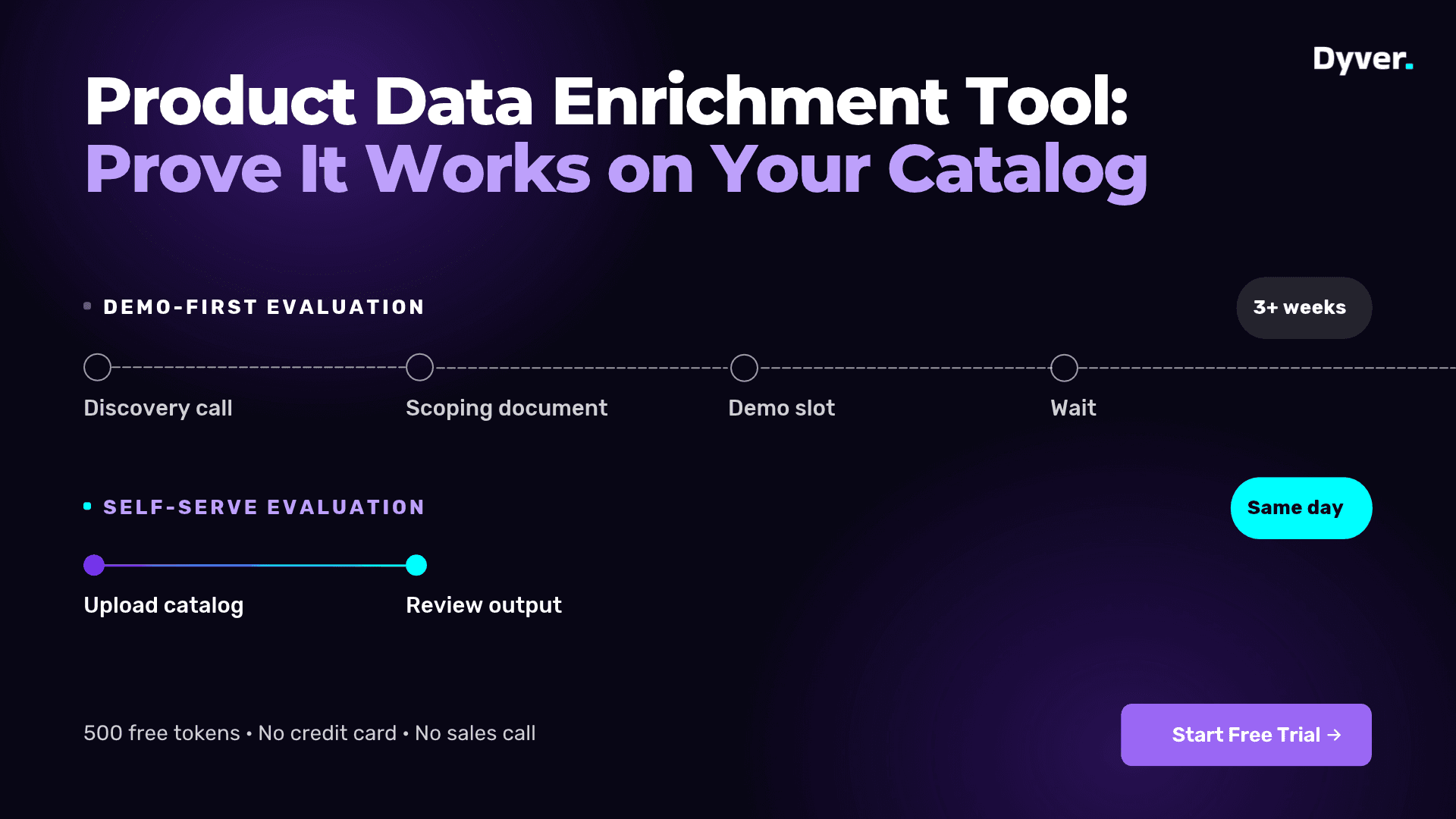
There is no discovery call to sit through first. No scoping document to fill out. No waiting on a demo slot to open up on someone else's calendar.
- Upload a raw supplier export, a partially formatted feed, or a spreadsheet full of gaps exactly as it sits in your systems today.
- Run it through Dyver with 500 free enrichment tokens, no credit card required to get started.
- Review the structured result yourself, on your own timeline, before talking to anyone on our team.
If you want to see how the same engine holds up at full catalog scale once you have tested it yourself, the Dyver product page walks through the complete workflow.
What to Check When You Test AI Product Data Enrichment Yourself
Not all structured output is equally useful, so a quick skim of the result is not the same as a real evaluation. Look past the polish and check the parts that decide whether this holds up in production.
Here is what that testing looks like in practice. You upload your product data as it is, incomplete fields, inconsistent formatting, whatever shape it is in. Then, describe your target format and validation rules in plain language, with no specs or templates required.
From there, you let Dyver's AI Assistant take over. It compares your input to your desired output, asks clarifying questions to close the gap, and designs a complete enrichment workflow automatically. You can adjust parameters or ask questions while the workflow takes shape.
Once the workflow is ready, you run it and review the results directly in your catalog. You collaborate with the Assistant on any final tweaks, then run the final execution to get your fully enriched catalog data. Check that output against the criteria below.
- Category mapping accuracy against your real taxonomy, not just the top-level categories that are easy to get right.
- Attribute completeness on the fields that drive conversion, like specs, compatibility notes, and materials, not only the title and description.
- Consistency across near-identical products, so the same item from two different suppliers does not come back formatted two different ways.
- How the tool handles your worst rows, since the messiest SKUs in your file are the ones costing you time today.
- Whether the output is ready to publish on the specific marketplace or storefront you sell on, since generic structured data is not the same as channel-ready listings.
A demo never shows you your worst rows.
Why the Product Enrichment Free Trial Is Faster, Not Just Free
The real advantage is speed, not just the free tokens. Speed is the part that matters when you are trying to make a decision. You can see your results, your own products enriched, in a few minutes.
A discovery call, a scoping document, and a wait for a demo slot easily add two to three weeks before you see anything real. Self-serve compresses that same timeline down to however long it takes to upload a file and read the output.
- Evaluation cycles that used to run weeks of back-and-forth with a sales team now take an afternoon.
- For a team already stretched thin across a thousand-plus SKU catalog, that time back is not trivial.
- The fastest way to know whether something works is trying it yourself, not scheduling a call to be told about it.
The same logic explains why enrichment pays off immediately once it is running in production. We laid out that operational math in Product Data Enrichment Improves Both the Top and Bottom Line. The evaluation phase follows the same pattern: the sooner you see the real result, the sooner you can act on it.
The Free Trial Is the Proof of Concept, Not a Random Test
The 500 free tokens are not a preview of a proof of concept. They are the proof of concept. Once your catalog comes back structured and enriched, you already have the evidence a POC exists to produce.
From there, moving to paid use does not require a call. You buy more tokens and continue in the same workflow you already tested, on your own schedule.
- Your test run is the evidence itself. There is no separate POC stage to schedule or wait on.
- When you are ready for more volume, you purchase additional tokens and continue in the same workflow, without a scoping call or contract negotiation first.
- Tokens never expire, with no subscription and no annual contract. This is a product data tool no subscription model, so you scale usage at your own pace.
Enrichment quality also decides how your catalog performs once it is live, both in traditional search and in AI shopping tools. We cover that shift in AI Agents Are Now Your Storefront. Your Product Data Decides If You Show Up., which is worth reading once you have proven the case on your own catalog and want to see what enrichment unlocks downstream.
Why We Built Self-Serve as the Front Door, Not the Back Door
Self-serve exists because of a gap we kept running into: the time between deciding to evaluate an enrichment tool and actually seeing it work. That gap costs a team weeks it does not have, especially with a thousand-plus SKU catalog waiting on the other side.
We built the free trial to close that gap directly. Instead of a sales conversation standing between you and your first result, you go straight to your own data and your own answer. The fastest way to bring value is to let you find it yourself, on your own timeline.
That same idea shapes the rest of how we work. We would rather let the evidence speak for itself once your catalog comes back structured and usable than lead with a pitch. Understanding the actual problem in front of you matters more to us than impressing you with a slide deck.
That is the gap we set out to close: not who could claim self-serve first, but how much faster a team can get from "we should look into this" to "this works on our catalog."
Takeaways for E-Commerce
- A demo shows you a curated example. It does not tell you whether enrichment works on your actual catalog.
- Self-serve access lets you test on your own raw data without a sales call, from the first upload to the final result.
- Speed, not just free tokens, is the real advantage. Evaluation compresses from weeks down to however long it takes to upload a file and review the result.
- The product enrichment free trial is the proof of concept. Once it proves out, you buy more tokens and continue in the same workflow, with no sales call required.
- Self-serve closes the gap between deciding to evaluate a tool and actually seeing it work, so you reach proof faster.
- The catalog you upload becomes your own evidence, more convincing than anything a demo could show you.
The fastest way to know if enrichment works on your catalog is to run it yourself. Everything else is just someone telling you about it.
P.S. If your catalog includes pricing, supplier terms, or other data you are not ready to upload, you do not have to. An AI-Guided Demo is available on the Dyver homepage and walks through the full workflow without any of your own data.
Updated on September 2, 2026