
AI Agents Are Now Your Storefront. Your Product Data Decides If You Show Up.
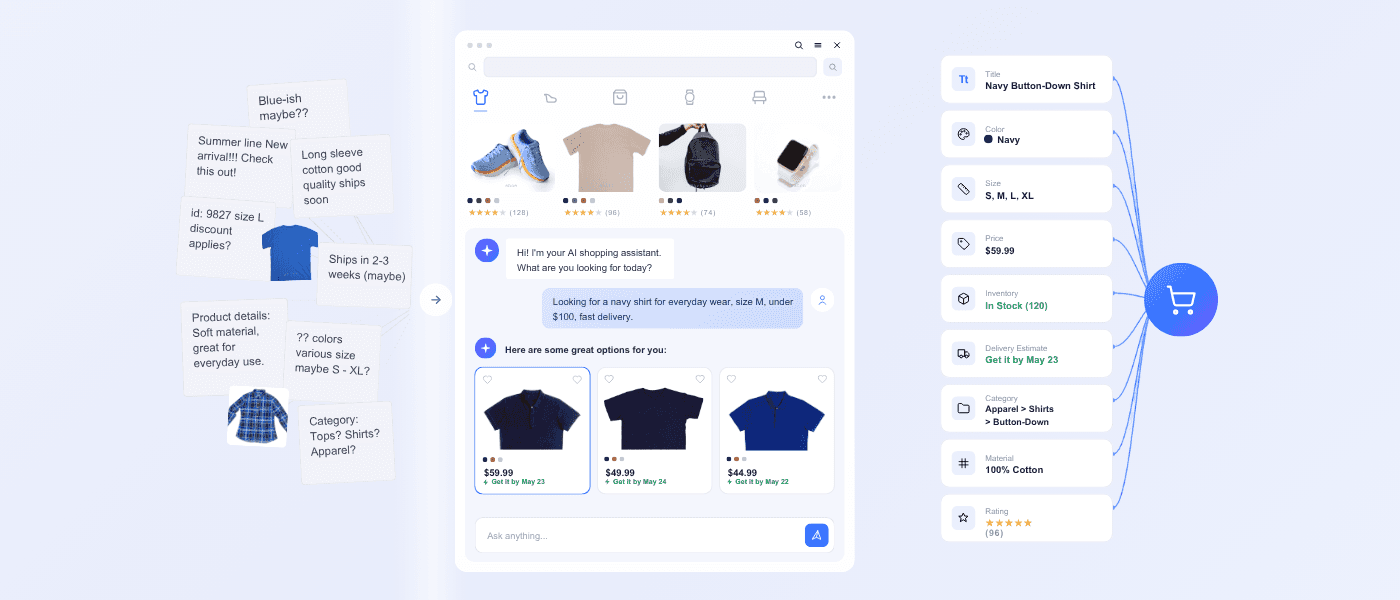
Shopify just put a number on a question operators have been arguing about internally for years: clean product data converts at 2x the rate of scraped data in AI-powered shopping. That number comes from Shopify Catalog, the structured product layer now feeding ChatGPT, Microsoft Copilot, Google AI Mode, and the Gemini app. If your catalog is full of missing attributes, inconsistent titles, and copy-pasted descriptions, you are not just ranking lower in AI results. You are invisible.
What Agentic Commerce Actually Is
AI agents are no longer just answering questions. They recommend products, add items to carts, and complete purchases on behalf of shoppers. Shopify's Spring '26 Edition formalizes this shift with three core pieces of infrastructure.
Shopify Catalog is a global, structured dataset spanning billions of products. When a shopper asks ChatGPT "what is the best waterproof jacket under $200?", Catalog is what feeds the answer. The Universal Commerce Protocol (UCP) is the open standard for how AI agents transact with merchants, co-developed with Google and already backed by Amazon, Meta, Microsoft, Stripe, Walmart, Target, and Wayfair. Agentic Storefronts give merchants a central dashboard in the Shopify Admin to manage which AI channels they appear on, track conversions from each, and identify catalog gaps.
The practical upshot: commerce is happening in chat interfaces, productivity tools, and search engines, not just on your website. If your product data is not structured for machines to read, agents skip you.
The 2x Conversion Gap Is a Data Quality Problem
Shopify reported that AI searches powered by its Catalog convert at twice the rate of those using scraped data. That gap is not a platform advantage. It is a data quality gap.
Scraped data is messy. It picks up whatever HTML sits on your product page: truncated titles, missing size attributes, outdated pricing, descriptions written for humans rather than for structured data schemas. AI agents need the opposite: clean fields, consistent taxonomies, and real-time accuracy.
- A product with a complete title (brand, product type, key attribute) surfaces correctly in AI queries.
- A product with a vague title ("Blue Bag Model 3") either surfaces incorrectly or does not surface at all.
- Missing delivery estimates, size ranges, and color attributes reduce the agent's confidence in the recommendation.
- Inconsistent category tagging means your product sits in the wrong bucket when the agent filters by type.
- Outdated stock information means the agent recommends a product the shopper cannot actually buy.
For a 50-SKU catalog, fixing this manually is annoying. For a 1,000+ SKU catalog, it is operationally impossible without automation.
What Shopify's Catalog API Now Expects from Your Data
The Spring '26 Edition expanded what Catalog API can do. Image search. Multi-modal search combining text and images. A lookup endpoint that resolves product URLs into real Catalog matches. Richer metadata fields including size, color, and delivery estimates.
Each of these features depends entirely on how well your product data is structured.
- Image search only works if your product images are clean, properly labeled, and linked to the correct SKU.
- Multi-modal queries need product titles and descriptions that match what images show, because the agent cross-references both.
- Richer metadata fields like size and color need to be filled consistently across every variant of every product, not just on flagship items.
- Delivery estimates need to be accurate and maintained in real time, not copy-pasted from a default template.
- The lookup endpoint resolves URLs to Catalog matches, which only works when your product URLs are clean and your data is consistent across platforms.
None of this is achievable with a spreadsheet and a part-time data entry hire. If you want to understand what this looks like at the catalog level, 8 Ways AI Prepares Your E-Commerce Catalog for Scale covers the operational approach in detail.
The Catalog Is Also a Search Quality Signal
Shopify's Agentic Storefronts dashboard now shows merchants the top AI queries in their category, which ones they rank for, and where they are not showing up yet. It also flags when products surface in AI conversations but fail to convert.
This is effectively an AI search audit built into the platform. And the fix, when a product surfaces but does not sell, is almost always the catalog data.
Sidekick, Shopify's AI assistant, tells merchants exactly what to change: adding specifications to product titles, improving descriptions, filling in missing product details. That guidance is useful. Executing it across thousands of products is where most teams get stuck.
- A single product fix takes minutes.
- A catalog-level fix across 2,000 SKUs, maintaining consistency across attributes, categories, and channel-specific requirements, takes weeks.
- If your product line changes seasonally, that fix cycle repeats every quarter.
- If you sell across multiple markets or marketplaces, each channel may require a different data format.
The audit capability is only useful if you can act on what it tells you at scale. The same principle applies to traditional search: bad data does not just hurt AI channels. It hurts everything downstream, including checkout. For context on where catalog issues show up in the purchase funnel, see The Most Common E-Commerce Checkout Mistakes and Why They Kill Sales.
Why This Goes Beyond Shopify
UCP already has backing from Amazon, Meta, Microsoft, Salesforce, Stripe, Etsy, Target, and Wayfair. This is not a Shopify-only standard. It is the emerging infrastructure layer for how AI agents transact across the entire e-commerce ecosystem.
That means the same product data quality problem exists whether you run on Shopify, Magento, WooCommerce, or a custom platform.
- Any brand that wants to sell through AI channels needs structured, machine-readable product data.
- The AI agent does not care which platform you use. It cares whether your data is clean.
- Brands using Shopify's new Agentic plan (available even without a Shopify storefront) still need to feed clean data into Catalog to surface accurately.
- As UCP adoption grows across Amazon, Meta, and Google, the catalog quality bar rises for every e-commerce operator, regardless of platform.
The agentic commerce shift is not a Shopify feature. It is a new requirement for being findable in the next generation of search and discovery.
What Changes for Large Catalog Operators
Most of the operator conversation around agentic commerce focuses on which AI channels to activate. That is the wrong place to start.
Activating AI channels with poor catalog data is like opening a new storefront with half your products missing price tags and the rest mislabeled. The channel works. Your products do not.
For operators managing 1,000 or more SKUs, the real question is: do you have a system that maintains catalog data quality continuously? Not at launch, not after a product audit, but on an ongoing basis as products change, prices update, variants multiply, and new channels open.
- Catalog data degrades over time. New variants get added without consistent attributes. Product titles drift. Categories get reassigned manually and inconsistently.
- AI channel requirements are stricter than traditional SEO requirements. Agents need machine-readable structure, not keyword-stuffed descriptions.
- Maintaining data quality manually at scale creates a bottleneck that grows with your catalog, not with your revenue.
- The operators who treat catalog data as infrastructure, not as a one-time project, are the ones building a compounding advantage.
The Shopify 2x conversion stat is a starting point. The ceiling on that number depends entirely on how clean and complete your data is.
Takeaways for E-Commerce
- AI agents are now a sales channel. Products surfacing in ChatGPT, Copilot, and Google AI Mode convert at 2x the rate of scraped data results, according to Shopify.
- Agentic commerce favors structured data. Clean titles, full attribute sets, real-time inventory, and consistent category tagging determine whether an agent recommends your product or a competitor's.
- The data quality problem scales with your catalog. At 1,000+ SKUs, manual fixes are not a strategy. You need a system that maintains data quality continuously.
- UCP is becoming an industry standard. Amazon, Meta, Google, and Stripe are all supporting it. The quality bar applies to every e-commerce operator, not just Shopify merchants.
- The audit tools exist. Shopify now shows you exactly where your products fail to surface or convert. The bottleneck is execution at scale.
- Product data quality is now a distribution lever. It has always affected on-site conversion. Now it decides whether you show up in AI-powered channels at all.
The operators who treat catalog data as infrastructure are building a compounding advantage. The ones who treat it as a back-office task will spend the next two years chasing AI channels their products never actually reach.
See how Dyver prepares catalog data for AI-powered commerce at scale. →
Sources
Updated on July 8, 2026