

Product Data Enrichment Improves Both the Top and Bottom Line
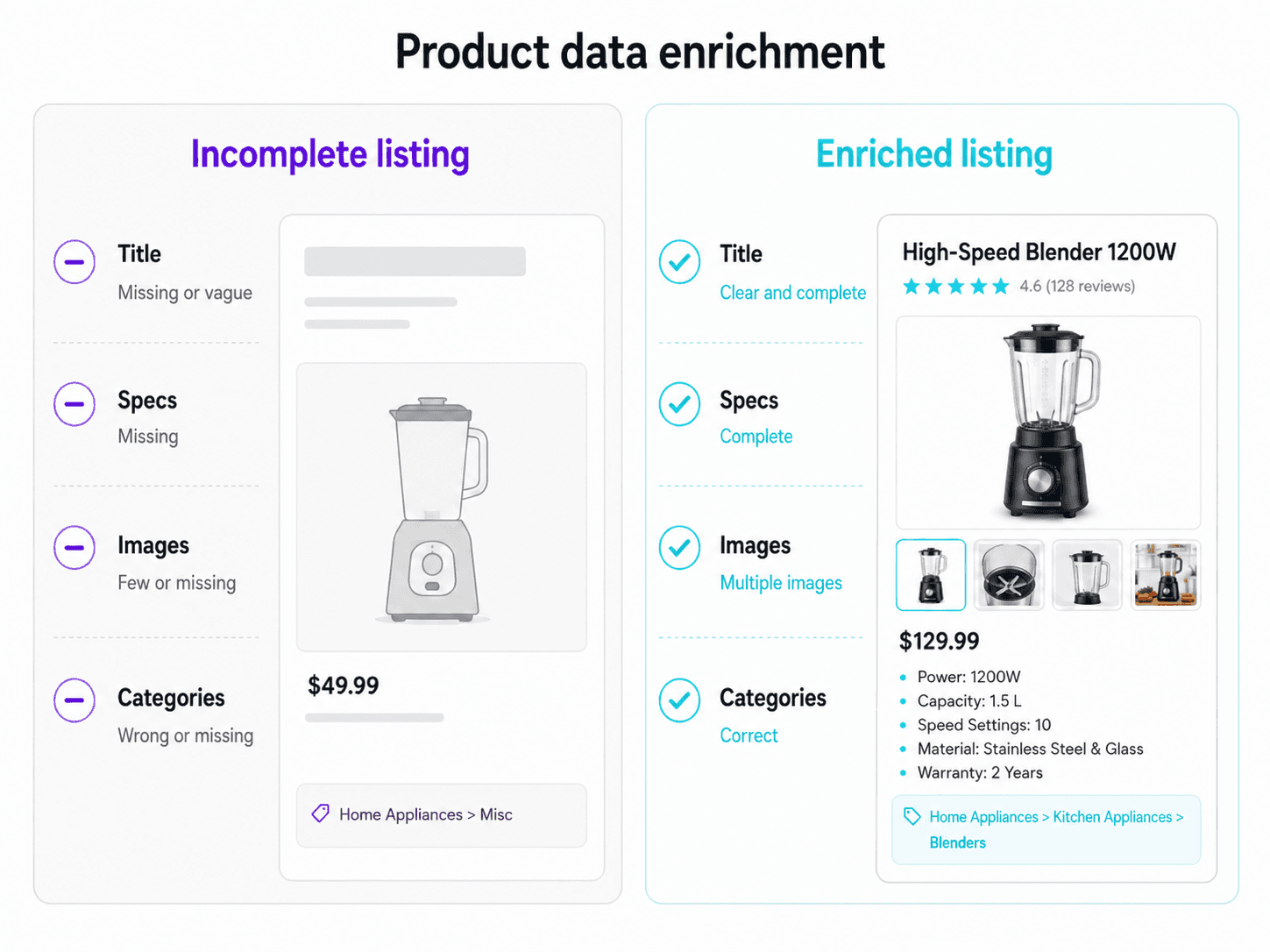
Every product sitting in your catalog with a missing attribute, a thin description, or the wrong category is not neutral. It is either costing you money right now or leaving money on the table. Most operators treat enrichment as prep work, something that happens quietly before the real business starts. That framing misses where the actual P&L impact sits.
The Bottom-Line Case: Enrichment Lowers Operational Costs Immediately
Manual data entry, spreadsheet reconciliation, and outsourced cleanup make up the default cost structure for catalog growth. Enrichment automates that layer, and the savings show up in the very next billing cycle, not in some future roadmap.
The bigger win is not just time saved. It is what your team gets to do with the time back.
- Merchandising hours that once went into fixing categorization and filling in missing attributes get freed up for pricing, promotions, and assortment strategy.
- The cost of onboarding each new supplier drops, because the enrichment workflow takes on the formatting and cleanup work on its own.
- Outsourced data cleanup, a recurring line item for many catalogs, gets folded into a process that already runs itself.
- The savings compound. Every SKU you add after the first one costs less to process than the one before it.
For a broader view of where automation fits across the full catalog workflow, not just enrichment, see 8 Ways AI Prepares Your E-Commerce Catalog for Scale.
A Shorter Path From Signed Supplier to First Sale
A signed supplier agreement is not revenue. A published, enriched listing is. Automated enrichment turns a ramp that used to take weeks into one that takes days, so every new supplier relationship starts generating revenue sooner.
- The time between "supplier agreed to sell" and "product is live and findable" is the real revenue ramp, and enrichment is what shortens it.
- Even a few days gained per launch adds up fast across a 1,000+ SKU catalog, compounding into a meaningful revenue gain over a year.
- Faster publishing also means faster feedback. You learn which new products actually sell sooner, and can double down on sourcing decisions while the window is still open.
- Every supplier relationship you bring on faster is one more revenue stream compounding earlier than it otherwise would.
Complete Data Converts Better, Especially in B2B
Customers value rich, informative product data. That is well established, and it is even more true in B2B, where buyers actively look for the detail they need to make a confident, fast decision.
- Buyers want the specs, compatibility notes, and use case detail that let them decide with confidence, without a follow-up call.
- Complete descriptions build the kind of trust that turns browsing into buying, and price becomes a secondary factor in the decision.
- Complete data does more than inform the buyer. It gives them everything they need to say yes on the spot.
- This conversion lift shows up in the catalog you already have. You do not need a single new visitor to capture it.
Product data builds the same buying confidence early in the funnel that a smooth checkout builds at the very end. For the other side of that story, see The Most Common E-Commerce Checkout Mistakes and Why They Kill Sales.
Enrichment Decides Whether You Show Up in Search and AI Shopping Tools
Discoverability is no longer just a search engine problem. It now runs through two separate systems, and enrichment is the input both of them depend on.
Search Engines Still Reward Complete, Structured Content
- Search engines rank complete, keyword-rich, well-structured product content above thin listings, consistently and predictably.
- Enriched data increases the number of queries your catalog can realistically rank for, not just your top sellers.
- Higher rankings mean more qualified organic traffic reaching your storefront without added ad spend.
AI Shopping Assistants Only Recommend What They Understand
- Shoppers increasingly compare and choose products through AI shopping assistants rather than a traditional results page.
- These tools recommend what they understand well. Rich, structured, machine-readable data gets surfaced and compared favorably, giving well-documented products a real edge.
- Enrichment is what puts your catalog in the running for these recommendations in the first place, no matter how strong the underlying product is.
This shift from ranking in search results to being recommended by an AI agent is covered in more depth in AI Agents Are Now Your Storefront. Your Product Data Decides If You Show Up.
Fewer Hallucinations, More Accurate Answers
- A shopping bot or support agent answering a customer's product question is only as accurate as the data behind it.
- Well-structured, complete product information gives these systems a reliable foundation to draw precise, correct answers from.
- Accurate answers build customer trust in your brand, every time a bot or assistant speaks on your behalf.
Enrichment Makes Your Platform Easier for Suppliers to Sell On
Suppliers have traditionally had to reformat their product data to match each merchant's specific taxonomy, attributes, and listing requirements before they could sell through that merchant. AI enrichment takes that work off their plate, which makes your platform a genuinely easier place to do business.
- Suppliers can send their data in whatever format they already use, and the enrichment workflow handles the transformation into your required structure.
- That means a faster, smoother start to every new supplier relationship, with the product live sooner on both sides.
- Less work required to list on your platform makes you a more attractive, lower-effort partner to sell through.
- That advantage matters directly when a supplier is deciding where to prioritize inventory across multiple retail partners, and it can tip the decision your way.
Takeaways for E-Commerce
- Enrichment lowers operational costs immediately by replacing manual data entry and outsourced cleanup with an automated workflow.
- It shortens the time between a signed supplier and a first sale, turning a weeks-long ramp into a days-long one.
- Complete product data converts better, particularly in B2B, where buyers commit faster when they have the detail they need.
- Enriched data is what search engines rank and what AI shopping tools recommend, giving well-documented catalogs the visibility edge.
- Structured product data helps shopping bots and support agents give accurate answers, building customer trust with every interaction.
- Easier supplier onboarding turns your platform into a more attractive place to sell, which strengthens supplier relationships over time.
Product data enrichment is a direct driver of revenue and margin. It sets the ceiling on how much value every other AI investment can deliver after it.
Updated on July 8, 2026