
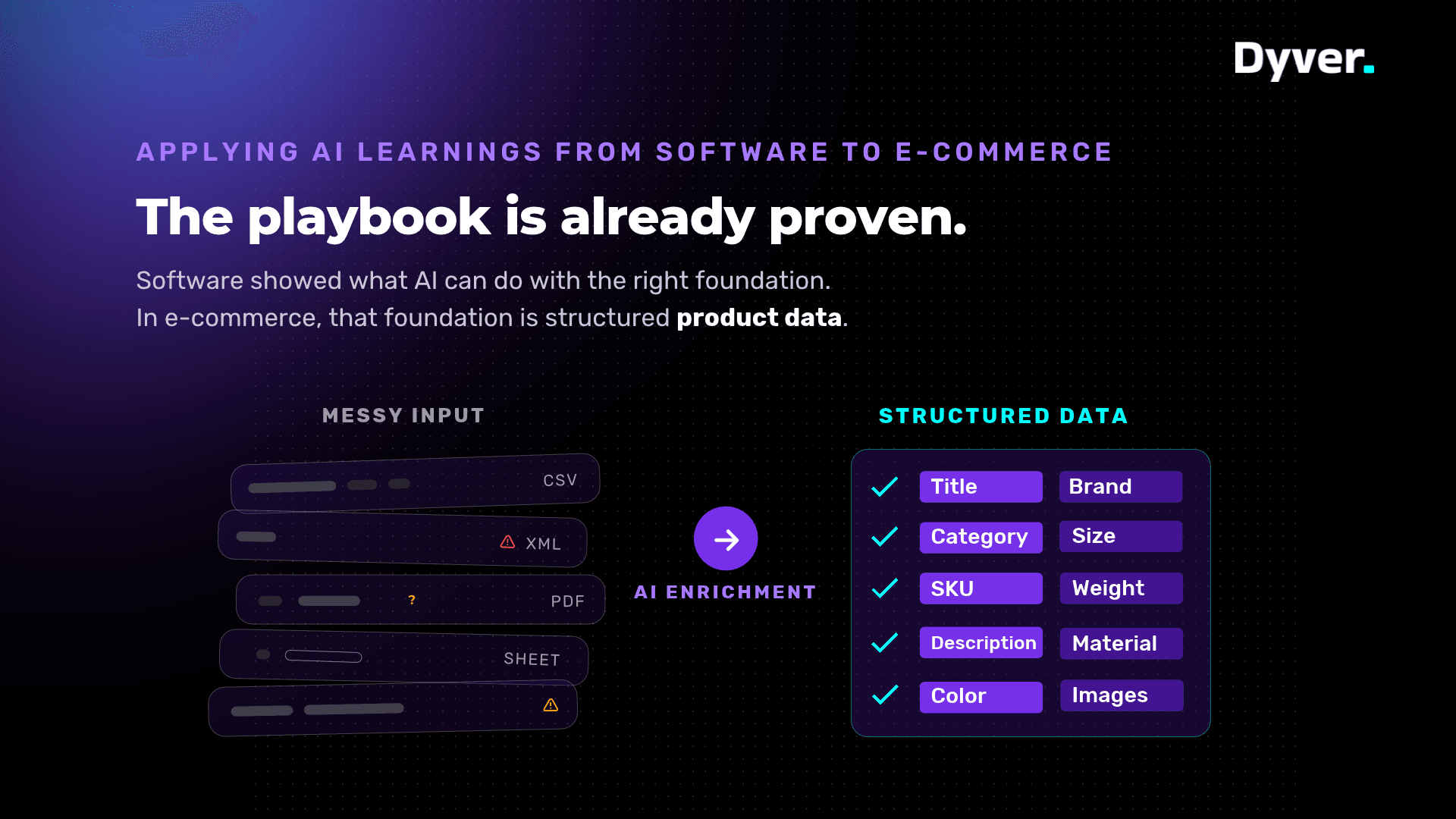
Applying AI Learnings From Software Development to E-commerce
Software development has already lived through the AI shift e-commerce is facing right now. Productivity went up, and costs came down by orders of magnitude. Software was the first industry to adopt AI at scale. It showed every other field what was possible once the right groundwork was in place.
Over the past years, Dyver.AI has been working on bringing the same principles that made AI so effective in software development to backend e-commerce operations, with a particular focus on improving product data quality.
Why product data?
Because every customer-facing AI initiative depends on the quality of the data behind it. Without accurate, structured product data, tools for customer support, recommendations, search, and shopping assistance are limited by the information they receive.
Before e-commerce businesses can get the full value from AI on the customer-facing side, they need to make sure the product data underneath it is ready.
The Challenges With Product Data Quality in E-commerce
Everyone in e-commerce complains about the quality of product data; every merchant understands how important it is, but the problem is persistent and refuses to go away.
- No shared standard: Every supplier, brand, or merchant defines product data its own way. Attributes, required versus optional fields, title and description style, even which image counts as the main one, all vary from one supplier to the next. The same product listed by two suppliers can read like two different products to anything trying to match them. Closing the gap is exactly what product attribute normalization is for.
- Too many sources, too many formats: Product data comes from suppliers, distributors, brands, manufacturers, and marketplace sellers, and each one hands over its own format. A merchant working with dozens of suppliers works with dozens of different data languages at once.
- Incomplete or incorrect data on arrival: In many cases, the product data a merchant receives is missing pieces or is simply wrong. Specifications left blank, a category misapplied, a dimension copied from the wrong model. Fixing that starts with the ability to fill missing product attributes.
- A different rulebook per channel: Most merchants sell through multiple sales channels, and each one enforces its own definition of acceptable data. The next channel can still reject data built to satisfy the first one. Marketplace feed requirements are exactly where that friction shows up first.
How Merchants Solve the Problem Today
Three responses show up across the industry, and each one leaves real value on the table.
- Manual work: People try cleaning up supplier product data, fixing titles, attributes, and images by hand, one product at a time. It works well at a small scale. Real value is waiting once the catalog, the supplier count, or the channel count grows beyond what a small team can keep up with by hand.
- Custom integrations: Some merchants build dedicated connections with their largest suppliers or sales channels to standardize product data automatically. These integrations work well for those specific partners, but they do not scale easily across the entire supplier base. As a result, a large part of the catalog can still require manual work.
- Ignoring it: Accepting the inefficiency and lost sales that come with bad data, rather than addressing it directly. Even modest improvements can help capture revenue that was already being lost.
There is no single standard for product data, but good practices and patterns do exist. Product Data Enrichment Improves Both the Top and Bottom Line walks through what fixing this is worth in revenue and cost. Applying AI to product data is where those patterns start to scale past what any of these three responses can manage alone.
Applying AI to Product Data Enrichment
The same ideas and approaches that made AI work in software development can apply directly to product data enrichment in e-commerce. Productivity rises once the data underneath becomes structured product data, and that is not a small claim. E-commerce runs on processes well beyond the product page itself that all stand to gain from it.
- Catalog management: Keeping thousands of listings current, correct, and consistent as suppliers and SKUs change. That beats relying on a manual product catalog audit every time something drifts.
- Price optimization: Setting and adjusting prices across products and channels works best when the underlying product data is accurate and current to begin with.
- Sales channel management: One structured source can power multichannel product listing across every marketplace, webshop, and feed a merchant sells through. That beats rebuilding the catalog by hand for each one.
- Customer experience: Every answer a support agent or an AI assistant gives about a product or an offer draws on the same underlying data. Strong data there makes every one of those answers better. AI Search Is Not Broken. Your Product Data Is. covers this side of the opportunity in more depth.
- Logistics: Planning grows more reliable with specs, dimensions, and stock data that are right from the start. That accuracy carries all the way to the warehouse and the shipping label.
These processes reach their full potential once the underlying product data is accurate, complete, and structured the same way across every supplier and channel. That structure is what lets an AI tool built on top of it perform the way it is meant to. Why Structured Product Data Outperforms Plain Text breaks down why that structure wins over plain descriptions at every one of these tasks.
Takeaways for E-Commerce
- Software development already proved what AI can do for productivity and cost, once the underlying work was structured enough to use.
- Product data quality is e-commerce's version of that same starting point. Four reasons keep it inconsistent: no shared standard, too many source formats, incomplete or wrong data on arrival, and a different rulebook per channel.
- Manual work, one-off integrations, and ignoring the problem are the three ways merchants cope with it today. Structuring the data is what turns that gap into growth.
- Good practices and patterns exist even without one industry standard, and applying AI to structure product data is where they start to scale.
- Once product data is structured, the same gains reach catalog management, pricing, channel management, customer experience, and logistics.
- Strong, structured product data is what lets any customer-facing AI initiative perform at its best.
Software development already ran this experiment and came out ahead. E-commerce already knows how the story ends. Structure product data first, and every process built on top of it gets the same lift.
See how Dyver structures product data for AI-ready catalogs at scale. →
Updated on August 24, 2026