

AI Search Is Not Broken. Your Product Data Is.
A 2,000-SKU catalog rarely has the same problem twice. One category is missing size charts. Another has product names copied straight from a supplier feed, with none of the material or fit details filled in. A third category has three different spellings for the same color. None of this caused much trouble when a person was doing the searching. A shopper could work around it without thinking twice. It becomes an immediate problem the moment an AI system is the one reading your catalog instead.
Why AI Cannot Work Around Gaps a Shopper Would Ignore
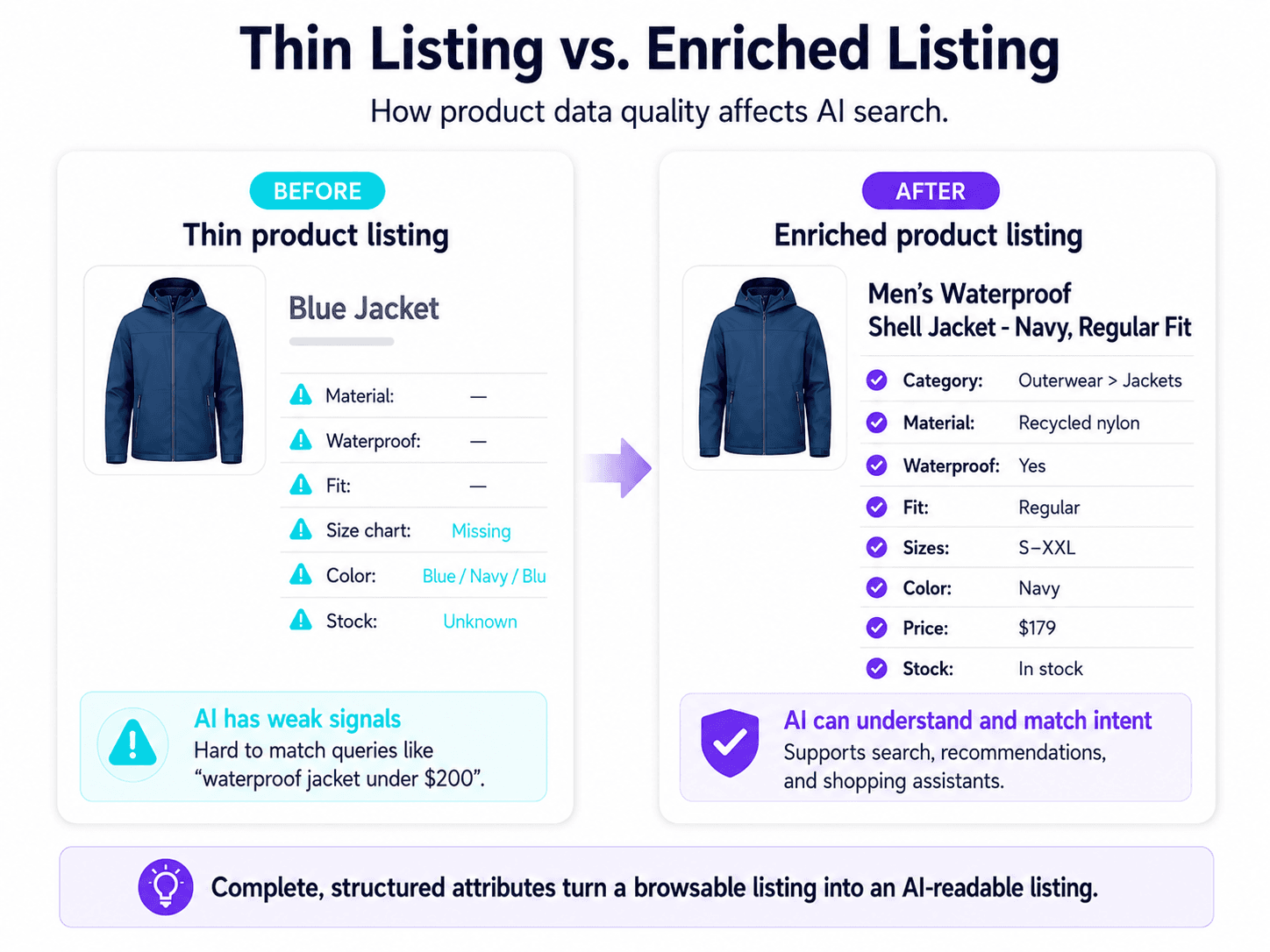
A shopper browsing your website can compensate for a lot. They can guess what a blurry product photo shows. They can infer a missing size from context. They can forgive a typo in a title or a category that does not quite fit. AI does not have that flexibility. It works only with the structure and content it is given, and it treats every gap literally.
- Missing attributes leave AI with no signal to match an intent-based query like "waterproof jacket under $200."
- Inconsistent naming across categories confuses the matching logic AI relies on.
- Duplicate or conflicting entries reduce the AI's confidence in any single answer.
- Outdated stock or pricing data leads to recommendations for products a shopper cannot actually buy.
As covered in Why E-Commerce Search Breaks, even keyword-based systems struggle when product data is inconsistent. AI-powered systems raise that bar considerably further, since they depend on meaning and context, not just on matching words.
What Incomplete Data Actually Costs You Across the Funnel
Retraining a model, rewriting prompts, or switching AI vendors rarely fixes what is actually broken. Most AI shortfalls trace back to something far less exciting than a broken algorithm: the product catalog feeding the system. Search relevance, recommendation quality, and shopping assistant accuracy all depend on the same input: structured, complete, and consistent product data.
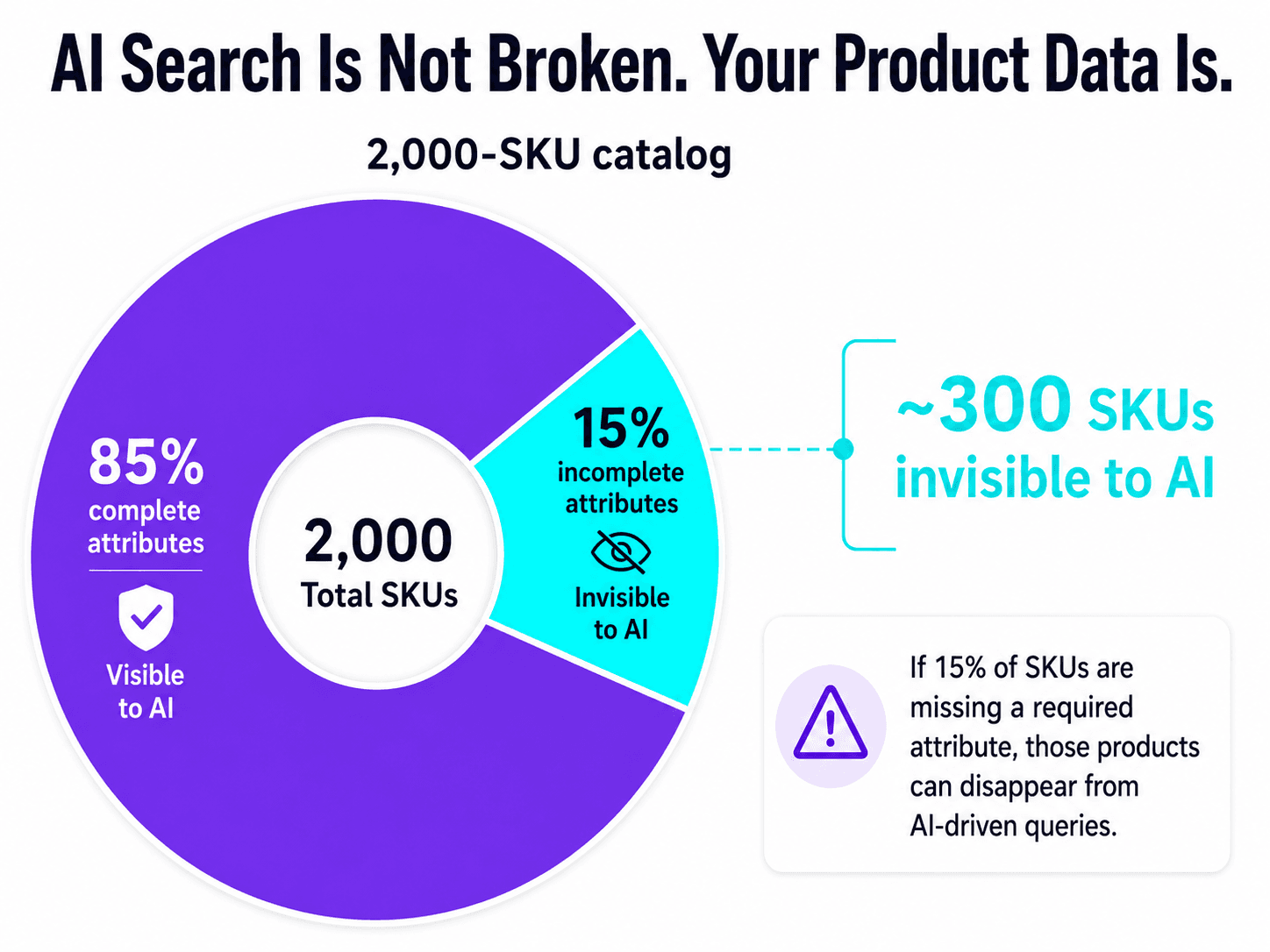
Run the math on a mid-size catalog, and the scale of the problem becomes clear. If 15 percent of SKUs in a 2,000-SKU catalog are missing a single required attribute, that is roughly 300 products invisible to any query built around that attribute. Multiply that gap across five or six commonly searched attributes, and a catalog that looks 90 percent complete on a spreadsheet can behave as though a third of it does not exist to an AI system.
- Search engines return irrelevant results when product titles and descriptions do not match how shoppers actually search.
- Recommendation engines suggest the wrong products when attributes like size, color, or material are missing or inconsistent.
- Shopping assistants give inaccurate answers when the data they draw from is incomplete or out of date.
- Agentic commerce tools skip your products entirely when they cannot parse unstructured or messy listings.
Fix the catalog, and most of these symptoms tend to clear up on their own.
Your Catalog Was Built for Browsing, Not for Machines
Most product catalogs were never designed for this job. They were built to help a person scroll through a website and decide what to buy. That is a much simpler bar to clear than what catalogs are now expected to support: semantic search, personalized recommendations, shopping assistants, and agentic commerce tools that transact on a shopper's behalf without a person ever visiting your site.
- Semantic search needs attributes and context, not just keywords, to understand what a shopper means.
- Recommendation engines need consistent structure across the entire catalog, not just the top-selling SKUs.
- Shopping assistants need machine-readable data they can parse without a person there to explain the context.
- Agentic commerce tools need real-time accuracy on stock, pricing, and product details before they will complete a transaction.
As discussed before in AI Agents Are Now Your Storefront, AI agents already act as a sales channel. They recommend products, add items to a cart, and complete purchases directly, all on the strength of the data behind each listing. The structural side of this problem, how categories and attributes should be organized in the first place, was also covered in Why Product Taxonomy Determines Search, Discovery, and Scale.
The Real Reason This Work Keeps Getting Pushed Back
Catalog cleanup rarely gets treated as a revenue project. It gets treated as a cost center, something to fund only after the customer-facing AI tools are already live. That framing gets the sequence backwards. A signed supplier is not revenue. A published, enriched listing is. A missing attribute or a vague title costs you conversions every week it goes unfixed, whether a shopper or an AI agent is making the recommendation.
- Catalog work rarely has a clear owner, so it queues behind projects with a visible launch date.
- Every quarter of delay adds more inconsistent SKUs to the backlog, since new products keep entering the catalog regardless.
- Treating enrichment as pre-launch prep, instead of an ongoing revenue lever, is what lets the backlog grow unchecked.
- The gap between what your AI systems expect and what your catalog delivers widens with every quarter this stays a low priority.
The result is a business asking more of its AI systems every year while feeding them the same fragmented information underneath.
What a Clean Product Data Layer Actually Requires
Fixing this does not require a different AI model. It requires treating the catalog as a knowledge layer rather than a static list of SKUs. Here are three things that determine whether that layer holds up at scale:
1. Attribute Consistency Across Categories
- Every SKU in a category should share the same required attributes, not just the flagship items.
- Size, color, material, and compatibility fields need consistent formats, not free text that varies by supplier.
- Attribute completeness should be measured and tracked on an ongoing basis, not assumed to be fine.
2. Taxonomy Governance
- Categories need clear rules for where new products go, applied the same way every time a SKU is added.
- Taxonomy drift happens quietly, as new products get added without matching the existing structure.
- A taxonomy audit on a growing catalog should happen on a schedule, not only when something breaks.
3. A Single Source of Truth
- Product data scattered across a PIM, spreadsheets, and supplier feeds creates conflicting versions of the same fact.
- AI systems need one place to pull from, updated in real time, rather than a patchwork of exports.
- Validation, whether automated or human-reviewed, should happen before data reaches any AI-facing system.
Start With Your Highest-Traffic Categories, Not Your Whole Catalog
Fixing a 2,000-SKU catalog in one pass is not realistic, and trying to do it that way is usually why the project stalls before it starts. Start smaller. Pick the two or three categories that drive the most traffic or the most AI-assisted queries, and audit those first. Full attribute coverage, clean taxonomy, and validated pricing on your highest-traffic categories will move more of your search and recommendation performance than a partial pass across the entire catalog.
Diagnosing where the gaps are is the easy part. Closing them across a catalog of 1,000 or more SKUs, consistently and on an ongoing basis, is the real operational challenge. This is the specific problem Dyver.ai was built to address. It is one of several tools on the market built to take on the enrichment, attribute standardization, and taxonomy consistency work at scale, so a growing catalog can actually support the AI systems built on top of it.
- Rank categories by traffic or by how often they appear in AI-assisted search and shopping queries.
- Audit your top two or three categories first for attribute completeness, consistent naming, and accurate stock and pricing.
- Use what you learn on those categories to set the standard the rest of the catalog should match.
- Expand outward by traffic volume, not alphabetically or by product age, so the highest-impact gaps close first.
See how Dyver helps 1,000+ SKU catalogs build the product data layer AI depends on →
Takeaways for E-Commerce
- AI cannot work around a data gap the way a shopper can, so every missing attribute becomes a missing result.
- A catalog that looks 90 percent complete on paper can behave as though a third of it is invisible to AI, once gaps compound across attributes.
- Catalogs were built for browsing, and semantic search, AI agents, and shopping assistants now ask far more of them.
- Catalog cleanup gets treated as a cost center instead of a revenue lever, which is why it keeps losing the budget fight.
- A clean product data layer depends on attribute consistency, taxonomy governance, and one verified source of truth.
- Fixing your highest-traffic categories first delivers more impact than a partial pass across your entire catalog.
Treat your product data as the foundation of every AI investment you make, not as prep work you get to eventually. The catalogs holding up under AI scrutiny today started this work on their busiest categories long before their AI systems demanded it.