
Product Data Enrichment: More Revenue, Same Ad Budget
Every quarter, someone asks for more acquisition budget to drive more traffic and more impressions. There is a faster way to grow revenue sitting right in your catalog: the SKUs already live, waiting for the specs, sizing detail, and full descriptions that turn a visit into a sale.
The Real Growth Lever Behind Your Ad Budget
Growth teams default to spending more to get more. Raising the ad budget feels like the obvious lever, and it can work. On a catalog with thousands of SKUs, there is often a faster lever sitting right next to it: the product pages you already own.
A complete product page sells more of the visitors you already have, no extra ad spend required. Give shoppers the answers they are looking for, and the traffic you already paid for converts at a higher rate.
Growth teams often split conversion rate optimization and acquisition budgets into separate workstreams. One team buys clicks. Another team tests button colors and checkout flow. Product catalog management often falls between the two, which is exactly where the fastest gains are waiting.
If your team is still working to clean up a product catalog SKU by SKU, redirecting even part of that ad budget toward the catalog itself is where the quickest wins are.
A few signs your catalog has untapped growth waiting:
- Ad spend keeps climbing while conversion rate stays flat.
- New SKUs go live with placeholder descriptions "to be updated later."
- Category pages show inconsistent detail: some products fully specced, others with three words and a price.
- Marketing keeps testing creative and landing pages while the product page itself never gets touched.
None of this is a targeting problem. It is a data opportunity, and one of the easiest to act on.
What Complete Product Data Earns You at the Point of Sale
Shoppers buy on information. GS1 US surveyed consumers on what drives a purchase decision and found that 77% say detailed product information influences whether they buy, which means most of your audience is already primed to convert once the information is there How Product Data Influences Shoppers, GS1 US.
Baymard Institute's research on top-grossing e-commerce sites shows exactly where the opportunity sits. Shipping information is a clear example: 43% of sites fail to show shipping costs on the product page, even though 64% of shoppers look for it there before deciding Baymard Institute, Product Page UX Research. Fixing that alone puts you ahead of more than half the market. Return policy visibility follows the same pattern: 44% of sites do not display or link to return information on the product page, and 13% of users abandon a site over an unsatisfactory return policy, an easy segment to win back.
Every one of these gaps maps to a question a shopper asks right before they click add to cart. Answer it, and the traffic you already paid for starts converting at a higher rate.
Fewer Returns, More Margin
Complete data does not just win the sale. It protects the sale after it ships. DHL's 2025 e-commerce logistics research points to the same root cause from the other direction: without the ability to see, touch, or try a product, shoppers depend on accurate sizing, imagery, and description. Get that right, and returns drop 2025 Returns Trends, DHL eCommerce.
Every return you prevent saves you twice: no outbound shipping wasted, no return shipping, no restocking labor, no markdown on inventory that comes back. A complete product page earns that saving for free, every time it stops a mismatched sale before it happens.
Run the math on your own return rate by data-related reason codes, if your platform tracks them. Most operators find a meaningful share of that number is fixable simply by completing listings that oversold, undersold, or never specified what the buyer needed to know.
Same Traffic, More Revenue
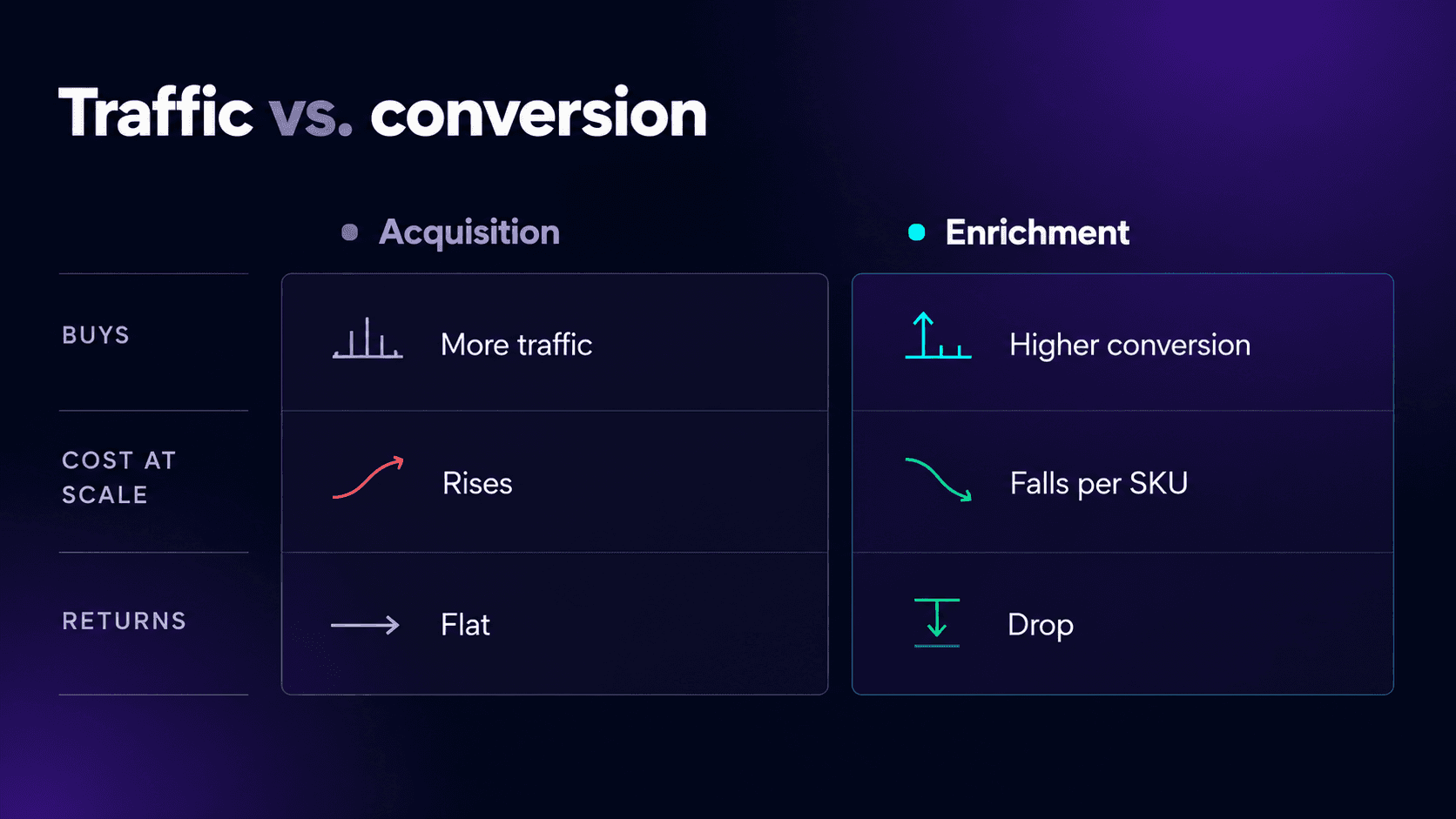
Compare the two levers side by side. One buys you more visitors. The other converts more of the visitors you already have.
| Lever | What it buys | Cost trend as you scale | Effect on returns |
|---|---|---|---|
| Paid acquisition | More traffic to existing pages | Rises with competition and ad fatigue | No effect, unless expectations are oversold |
| Product data enrichment | Higher conversion on existing traffic | Falls per SKU as processes scale | Drops as descriptions match reality |
Acquisition cost per click rarely goes down. Enrichment cost per SKU does, once you move from manual listing work to AI product data enrichment, a repeatable process that gets faster and cheaper as it scales. Enrichment buys you growth and efficiency from budget you are already spending on the catalog.
Enrichment compounds in a way acquisition never will. A completed product page keeps converting every visitor who lands on it, paid or organic, for as long as it stays live. An ad converts the click you paid for, then stops working.
Where to Start for the Fastest Wins
Not every SKU needs the same treatment first. Prioritize by where completing the data will win you the most conversions or prevent the most returns.
Technical Specifications
Dimensions, materials, compatibility, and capacity are the details buyers use to rule products in or out. Complete specs keep shoppers on your listing instead of sending them to a competitor's page that answers the question outright. Product attribute extraction and product attribute enrichment solve this at the data level: pulling structured specs out of messy supplier files instead of retyping them by hand.
- Start with high-traffic SKUs where spec fields are blank or inconsistent.
- Standardize units and formats across categories so filters and comparisons actually work.
- Pull specs from supplier data first before assigning manual research.
Marketing Content
Descriptions, benefit statements, and use-case framing are what turn a spec sheet into a reason to buy. Every strong SEO product description does two jobs at once: it persuades the shopper reading it and signals relevance to the search engine ranking it.
- Prioritize categories with the highest return rate or lowest conversion first.
- Write to the actual buying question, not a generic template.
- Keep language consistent with how your audience searches, not how your internal team names products.
- At catalog scale, pair a writer with a bulk product description generator to move faster, without giving up quality control.
Logistics Data
Shipping weight, dimensions, delivery windows, and return eligibility affect both conversion and post-sale cost. This is also where product feed optimization lives: the same fields marketplaces use to calculate delivery estimates and listing eligibility.
- Confirm shipping details are visible on the product page itself, not buried in a policy link.
- Sync logistics fields from source systems so they update automatically when packaging or carriers change.
- Flag any SKU where return eligibility rules are unclear or missing.
If you are asking how to list thousands of products fast without cutting corners on data quality, the answer is not more headcount. Product catalog automation, built upstream in the systems that feed every channel, lets enrichment keep pace no matter how fast the catalog grows.
Takeaways for E-Commerce Growth
- Acquisition spend pays off fastest when it lands on a page that is ready to close the sale.
- 77% of shoppers say detailed product information drives their purchase decision.
- Adding shipping and return information to product pages is a fast, well-documented way to lift conversion.
- Complete listings win more sales and prevent more returns, a double win from the same effort.
- Enrichment cost per SKU falls as you scale it through a process; ad cost per click does not.
- Prioritize technical specs, marketing content, and logistics data by where completing them wins you the most, not alphabetically down the catalog.
Your current catalog is already getting traffic. Complete it, and that same traffic starts converting at a higher rate, before you spend another dollar on acquisition.
See how Dyver's product data enrichment software fills every gap in a catalog at 1,000+ SKU scale, or explore the Dyver product directly.