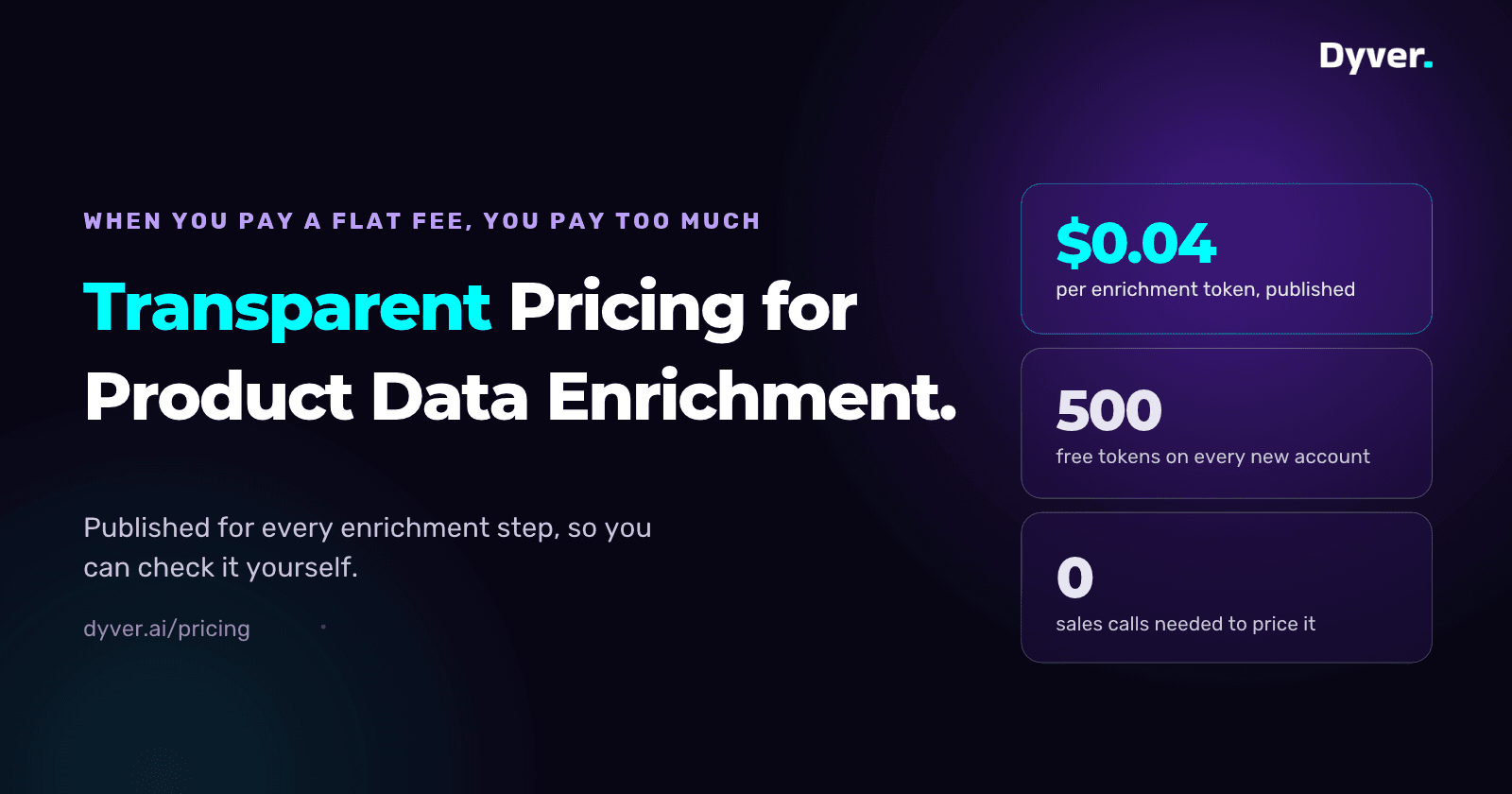
When You Pay a Flat Fee, You Pay Too Much. Introducing Dyver's Transparent Pricing for Product Data Enrichment
Flat per-SKU pricing charges the same amount whether a listing needs a one-line refresh or a full rebuild from raw supplier data. Simple products end up subsidizing the complex ones, and you pay an average rate for work that was never actually done, SKU by SKU.
Dyver's pricing works differently. Every self-service workflow runs on Enrichment Tokens, priced by the complexity each step requires, so the cost you see is the cost of the actual work, not an average. That cost shows up before you click run, no call required. As far as we know, that also makes Dyver.ai the first company in product data enrichment to publish full, itemized pricing this way. Here is how it works, and why we would love to see the rest of the category adopt it too.
How self-service pricing works
An Enrichment Token, or ET, is the unit Dyver's pricing runs on. One ET costs $0.04.
A step is one discrete unit of AI work performed on a SKU: writing a description, extracting attributes, cleaning up an image, translating a listing for a new market. Each step has a fixed ET cost, set by its complexity and the value it adds, not by who you are or how big your order looks.
Together, tokens and steps are how a workflow gets priced. Add up the ET cost of every step a SKU needs, multiply that total by $0.04, and you have the exact cost for that SKU.
Some pricing models charge the same flat rate per SKU no matter what work is involved, which averages a simple title refresh and a full raw-data rebuild into one number. Step-based pricing lets you pay for the actual work each SKU needs, whether that is a quick refresh or a full enrichment build.
Before you run any job, Dyver shows you the exact cost per SKU, calculated from the exact steps that job includes. That number does not move once you commit. What you saw during setup is what you pay.
Budget based on steps, not guesswork
Flat per-product pricing forces every catalog into the same box, whether a listing needs a one-line refresh or a full rebuild from raw supplier data. We priced it differently: every workflow is built from individual steps, and you only pay for the steps a SKU actually needs. Here is what each step costs in enrichment tokens:
| Step | Enrichment Tokens | Cost |
|---|---|---|
| Find Product Data | 3 ET | $0.12 |
| Extract from webpage | 3 ET | $0.12 |
| Extract from document | 3 ET | $0.12 |
| Find files | 2 ET | $0.08 |
| Analyze images | 5 ET | $0.20 |
| Remove image background | 5 ET | $0.20 |
| Extract attributes | 3 ET | $0.12 |
| Map to category | 3 ET | $0.12 |
| Transform | 2 ET | $0.08 |
| Select images | 1 ET | $0.04 |
| Split images | 1 ET | $0.04 |
| Write | 1 ET | $0.04 |
| Translate | 1 ET | $0.04 |
| Change image file | 1 ET | $0.04 |
| Code | 1 ET | $0.04 |
You build your own workflow by combining these steps in whatever mix your product data needs, and different batches of products can use different workflows. The price follows the work: add up the ET cost of every step in the workflow, and that total is the price per SKU.
Say one batch of SKUs needs enriching from a supplier catalog page. That workflow might combine Extract from webpage (3 ET), Write for the description (1 ET), Write for the title (1 ET), and Translate (1 ET), for a total of 6 ET. Multiply by the price of one token, $0.04, and the workflow costs $0.24 per SKU.
A second batch might only need a quick title and description refresh, at 2 ET. That workflow costs less, because it needs less.
Knowing your SKU count and which steps each workflow needs lets you build your enrichment token budget before you run a single job, not after. You can compare that to the cost of doing the same work manually and see exactly where the savings come from.
| Step | Enrichment Tokens | Cost |
|---|---|---|
| Write SEO optimized description in any language | 1 ET | $0.04 |
| Quick title & description refresh | 2 ET | $0.08 |
| Image cleanup for a product line | 7 ET | $0.28 |
| Translate & standardize a feed | 3 ET | $0.12 |
| Attribute extraction & categorization | 8 ET | $0.32 |
| Enrich from a supplier catalog page | 7 ET | $0.28 |
| Full enrichment from raw supplier data | 16 ET | $0.64 |
| Complete multi-market catalog buildout | 28 ET | $1.12 |
Pricing that adjusts to how you actually work
No two catalogs need the same workflow, so we did not build one price for all of them. Self-Service and Enterprise are built for different ways of working, and both carry the same transparency principle underneath.
Self-Service is for running projects as they come up. Tokens never expire: buy them once, and use them whenever a project comes up, across as many catalogs or markets as you need. There is no subscription, no contract, and no minimum commitment: you spend on the work you run, and nothing else. Larger token purchases unlock a lower effective price per token, so the cost per SKU drops as your volume grows, though getting the right volume discount at that scale still means a conversation with our team.
Enterprise is for merchants and marketplaces that need enrichment built into their infrastructure rather than run project by project. It is not a bigger version of Self-Service, it is built for a different need: a dedicated team, custom integrations, and a predictable budget matched to how the business actually runs, all priced on the same per-step logic.
Why we are publishing this at all
Public, itemized pricing is still rare in product data enrichment, and we wanted to be the first to change that. We believe cost is something anyone evaluating a platform should be able to look up on their own, whenever they want, before ever booking a call.
Publishing our pricing means anyone evaluating Dyver.ai can do the math themselves, compare it to the cost of doing the work manually or the cost of a flat per-SKU fee, and move at their own pace. That is the standard we would want as a buyer, so it is the standard we are holding ourselves to as a vendor.
We would love to see more of the category move this way. Product data enrichment and catalog automation are usage-based work at their core: you pay for the work done, on the SKUs that need it. Pricing that reflects that plainly is simply accurate, and we think it is good for everyone evaluating a platform like ours.
Quick answers
What is an enrichment token (ET)? A unit of Dyver's usage-based pricing. One ET equals $0.04. Every workflow step costs a fixed number of tokens, based on its complexity.
What is a step? One discrete unit of AI work performed on a single SKU: writing a description, extracting attributes, cleaning up an image, or translating a listing for a new market. A workflow can combine several steps per SKU.
How is the cost per SKU calculated? Add up the ET cost of every step a SKU needs, then multiply by $0.04. Dyver shows you that number before you run the job, and it stays the same afterward.
Key takeaways for eCommerce teams
- Flat per-SKU pricing charges the same rate regardless of the work involved, so simple products subsidize complex ones. Dyver prices by the actual steps each SKU needs instead.
- Every self-service job shows its exact cost per SKU before you run it, calculated from Enrichment Tokens (ET) and the steps involved. No quote, no waiting on a sales call.
- One ET costs $0.04. Each step, from a title refresh to a full raw-data rebuild workflow, has a fixed ET cost based on the work involved, not your order size.
- You can calculate your enrichment budget before running a single job, using your SKU count and the steps each product batch needs.
- Self-Service tokens never expire, and there is no subscription, contract, or minimum commitment behind them.
- Larger accounts get a lower per-token rate through a quick conversation with the team, while Enterprise is built separately for infrastructure-level needs like custom integrations and a dedicated team.
- As far as we know, Dyver is the first company in product data enrichment to publish full, itemized pricing rather than build every quote from scratch.
Updated on September 10, 2026