Dyver.ai Features
Discover, organize, and create product data from any source into structured, sell-ready content across every channel.
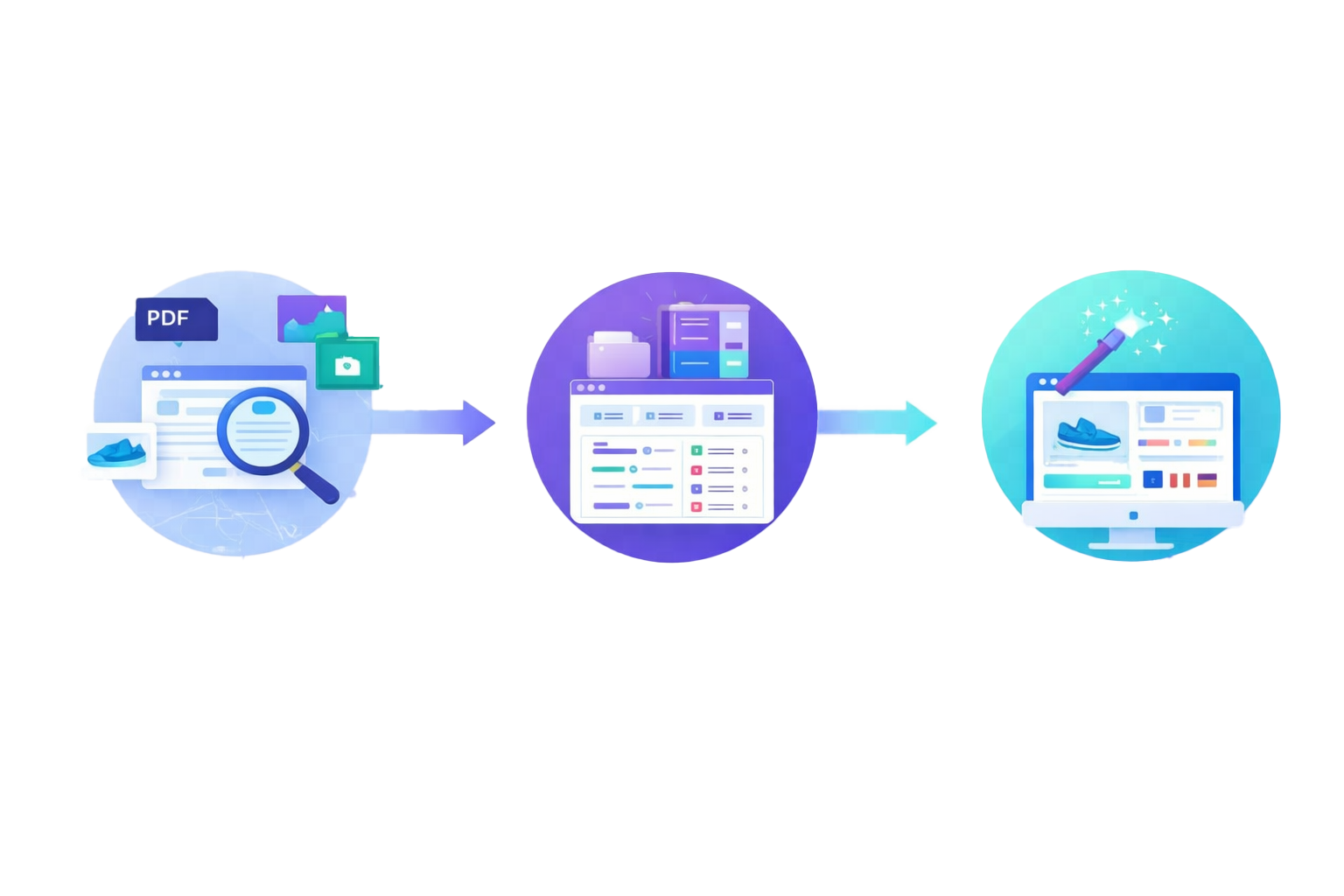
Discover. Organize. Create.
Dyver is the AI platform that turns fragmented, messy supplier data into structured, searchable, and sellable product listings.
It is not a rigid pipeline. It’s a flexible intelligence layer that adapts to how your data already exists.
That’s why Dyver is built around three powerful capabilities — Discover, Organize, and Create — which can be used independently or combined into end-to-end workflows.
Each capability combines deterministic rules with AI, large language models, and human-in-the-loop validation, providing both automation and control. You get accuracy at scale without ever losing trust in your data, because human expertise guides critical decisions where it matters most.
1. Discover — Compile complete information about a product
Most product data already exists somewhere — on supplier websites, in PDFs, in images, or across the web. Dyver’s first job is to find it, validate it, and bring it together.
This gives every product a richer, more reliable foundation — even when supplier data is thin.
How Dyver discovers product data:
Web search & discovery
Dyver can search the open web to locate missing or incomplete product information, filling the gaps in supplier feeds.
Supplier & manufacturer search
Limit Dyver to trusted sources — such as supplier websites, manufacturer pages, or specific URLs — to ensure accuracy and brand consistency.
Document & image discovery
Dyver extracts product information from:
- PDFs (spec sheets, manuals, catalogs)
- Images (labels, packaging, visual details)
- Text files and spreadsheets
2. Organize — Turn chaos into structured product intelligence
Raw data is useless unless it is understood, classified, and made consistent. Dyver transforms scattered inputs into clean, structured product models.
This creates a single source of truth across all suppliers, formats, and systems.
How Dyver organizes your catalog:
Attribute extraction & normalization
Dyver identifies and extracts attributes, even when they don’t exist as fields, from descriptions, documents, and images.
It then normalizes them into clean, filterable values across all sales channels.
Multimodal understanding
Dyver reads: text, images, PDFs
It can recognize dimensions, materials, features, and specifications — and even infer missing data from visual or textual cues.
Category & subcategory mapping
Dyver understands how products should be classified.
It maps each item to the correct category and subcategory, and automatically converts one supplier’s structure into another.
3. Create — Turn data into high-converting listings
Once your product data is structured, Dyver turns it into ready-to-publish content — written, formatted, and optimized for your business.
No manual cleanup. No broken imports. Just clean, usable product intelligence.
How Dyver creates your content:
Write in your brand voice
Dyver generates:
- Product titles & descriptions
- SEO & GEO content
All aligned with your brand tone, category rules, and platform requirements.
Translate at scale
Dyver translates your entire catalog into any language — while preserving brand voice, terminology, and commercial intent.
Format, map & export
Dyver adapts data to every platform:
- Reformat fields & convert units
- Merge or split attributes
- Apply templates or naming rules
- Map everything to the fields your PIM, marketplace, or website requires
Why this unlocks scale
Dyver doesn’t just “clean data.”
It understands products.
By combining deterministic rules with AI and LLMs, Dyver gives you:
- Faster product onboarding
- Better filtering and discovery
- Higher conversion rates
- Fewer returns
- And a catalog that scales with your business
From raw inputs → to structured intelligence → to high-impact commerce.